The Problem With Most Coloring Books
Most coloring books marketed to Black buyers share one problem: they change the face without changing the world around it. A brown-skinned figure in a generic kitchen, at a generic table, in a generic living room is not representation. It is a swap. Coloring Kinfolk was built on a different premise: the scene has to feel true before the page can do anything meaningful.
Walk into any major retailer or scroll any online marketplace and you will find shelves of adult coloring books. Some will be labeled multicultural. Some will feature brown and black figures. Some will call themselves Afrocentric. And nearly all of them will share the same structural problem: the cultural world depicted, the settings, the objects, the domestic architecture, the food on the table, belongs to nobody in particular.
Changing the skin tone is not the same as changing the world. The world is where memory lives.
— Coloring Kinfolk
The Problem Is Not the Face. It Is the Scene.
Portrait-based coloring books show people. Scene-based coloring books show lives. The distinction matters more than it sounds.
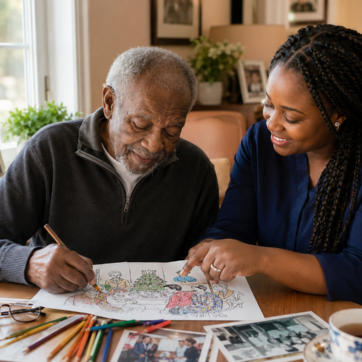
When a Black American elder sits down with a coloring page of a brown-skinned woman standing in a kitchen, she may appreciate the representation. But if the kitchen looks like a stock photo, with the wrong counter height, the wrong window placement, the wrong quality of afternoon light on a Sunday morning, she will not be transported. She will be mildly pleased. That is a different thing entirely.
Now give her a page where the cast iron skillet is in the right position. Where the pot on the stove is the kind her grandmother used. Where the kitchen table is set the way that table was set. Where the curtains, the colander, the dish rack, the particular way light comes through a window above a sink, all of it reads true. That page does not just represent her. It finds her. It says: this world existed. It was real. You were in it.
That is the clinical mechanism behind reminiscence therapy. And that is the problem most coloring books never solve, because solving it requires cultural specificity that cannot be achieved by changing a hex color code.
Why “Multicultural” Is a Marketing Word, Not a Design Standard
The word multicultural in coloring book marketing almost always signals that figures of multiple skin tones appear somewhere in the product. It does not signal that the cultural worlds depicted, the foods, the objects, the spaces, the domestic rituals, reflect any particular community’s actual lived experience.
This is not a failure of intention. It is a failure of process. You cannot design a culturally specific product without researching the culture. You cannot illustrate the Sunday Dinner table without knowing what was on it. You cannot draw Grandma’s kitchen without understanding what that kitchen meant, what it held, what it smelled like, what it produced, and why the memory of it persists across generations.
Most publishers skip that research. They commission illustrations from artists who are working from general references. The result is a book that looks diverse and reads generic. Black buyers recognize the difference immediately. They have been recognizing it for decades.
What Scene-Based Representation Actually Looks Like
Coloring Kinfolk is built around specific scenes drawn from Black American domestic and community life. Not figures. Environments.
The Sunday Dinner table: set the way that table was set, with the dishes that were always there, in a room that carries the particular weight of a Sunday afternoon when everyone was expected and nobody left early.
Grandma’s kitchen: not a kitchen. Her kitchen. The one with the particular organization, the particular equipment, the particular smell of something on the stove that you could identify from the front door.
The front porch: not a porch. The porch where the neighborhood moved through. Where the evening happened. Where things got said that would not have been said anywhere else.
The family reunion: not a generic outdoor gathering. The specific configuration of folding tables and lawn chairs and card tables and coolers that every Black family knows, arranged the way that particular family arranged them, at the park or the backyard or the church grounds.
These scenes are not illustrations of Black life. They are illustrations from Black life. The preposition is the product.
Why This Matters Beyond the Individual Buyer
The problem with most coloring books is not only a consumer problem. It is an institutional one.
Activity directors in memory care facilities, assisted living communities, and senior centers serve Black American elder populations with activity programming that was designed for nobody in particular. The research on reminiscence therapy is clear: culturally specific stimuli produce stronger memory activation than neutral stimuli for people living with dementia. A page that feels true to a resident’s actual cultural world does more clinical work than a page that merely includes a brown figure.
This is why Coloring Kinfolk offers institutional licensing for facilities, starting at $197 for a single facility. The cultural specificity is not an aesthetic choice. It is a programming decision with documented outcomes.
The Standard the Market Has Not Met
The adult coloring market is large, and the Black American segment of it is underserved in a specific way. Not underserved in volume, there are many products, but underserved in depth. Many pages. Few scenes that are true.
Coloring Kinfolk exists to hold that standard. Every page goes through a cultural specificity test before it is released: does this scene feel true to the specific world it depicts, or does it merely gesture toward it? The answer has to be true, or the page does not ship. Browse the full collection or download three free pages and see what the difference feels like.
Frequently Asked Questions
What Is the Difference Between a Multicultural Coloring Book and a Culturally Specific One?
A multicultural coloring book includes figures of multiple skin tones across its pages. A culturally specific coloring book builds its imagery from the actual cultural world of a particular community, including settings, objects, domestic environments, and community spaces that reflect real lived experience. Coloring Kinfolk is culturally specific to Black American domestic life, not multicultural in the general sense.
Why Does Scene-Based Coloring Work Better Than Portrait-Based for Memory Care?
Reminiscence therapy research shows that familiar environments and objects activate long-term autobiographical memory more effectively than faces or figures alone. Scenes carry contextual data, the smell of a kitchen, the arrangement of a table, the feel of a particular porch, that portraits do not. For people living with dementia, this contextual activation is the therapeutic mechanism. Portrait-based coloring produces recognition. Scene-based coloring produces memory.
Are Coloring Kinfolk Books Available for Institutional Use?
Yes. Institutional licenses start at $197 for a single facility and include facility-wide print rights, the Cultural Memory Companion with scene-specific memory prompts, and the Staff Implementation Guide. Multi-facility network licenses are $497. Visit the memory care coloring hub for details.
Where Can I See the Scenes Available?
Current scene sets include the Sunday Dinner table, Grandma’s kitchen, the front porch, the family reunion, the cookout, and the barbershop. Download three free pages at coloringkinfolk.com/free. Print editions are available on Amazon and digital downloads at the shop.
What Makes Coloring Kinfolk Different From Other Black Coloring Books on the Market?
Coloring Kinfolk is scene-based rather than portrait-based, and culturally specific rather than multicultural in the general sense. Every page is built around a specific environment drawn from Black American domestic and community life. The scenes are designed to activate autobiographical memory, support reminiscence therapy in care settings, and function as cultural preservation tools for Black American families.
The page in front of you should feel like home. Download three free pages and see what culturally specific actually looks like.
The world around the figure is where the memory lives.