You’re planning your family reunion. You’ve booked the pavilion, ordered the food, created the Facebook group. But you know from past reunions: without intentional activities, it becomes adults sitting in circles talking while kids run wild, and by hour three, everyone’s ready to leave.
Here’s how to create a Black family reunion that builds intergenerational connection, honors heritage, creates lasting keepsakes, and gives everyone—from toddlers to great-grandparents—something meaningful to do.
Why Most Family Reunion Activities Miss the Mark
The typical family reunion activity plan: bounce house for kids, maybe some yard games, lots of unstructured time. Kids get bored after an hour. Adults talk in circles by generation. Cousins who haven’t seen each other in years barely interact. Everyone eats, takes a group photo, and goes home.
Nothing wrong with this, but nothing memorable either. The reunion becomes a checkbox, not a tradition. And the intergenerational knowledge transfer that family reunions used to facilitate? It doesn’t happen organically anymore.
What’s Missing: Structured Intergenerational Connection
The problem isn’t lack of activities. It’s lack of activities that bring multiple generations together simultaneously. Separate kids’ activities and adult conversations don’t create family connection. You need activities where a 7-year-old and their 70-year-old great-grandmother can participate side-by-side.
That’s where coloring stations, memory sharing, and cultural keepsake creation come in.
RELATED: Why Black Family Coloring Pages Keep Our Stories Alive
The Anchor Activity: Intergenerational Coloring Station
Why Coloring Works for Family Reunions
Universal accessibility: A 4-year-old can color. A 94-year-old can color. It requires no special skills, no physical ability beyond holding a crayon, no literacy. Everyone can participate.
Conversation catalyst: Coloring keeps hands busy while creating natural pauses for questions and stories. “This reminds me of Grandma’s house…” becomes “Tell me about Grandma’s house.” The coloring page is the excuse for dialogue.
Cultural memory trigger: When the coloring pages show Sunday Dinners, front porches, church gatherings, family celebrations—scenes from Black American family life—elders remember. Kids ask questions. Stories get told.
Keepsake creation: Everyone leaves with something they made. Frame it. Put it on the fridge. You have a physical reminder of the reunion and the stories shared while coloring.
How to Set Up the Coloring Station
Location: Central area visible from main gathering space. Not isolated in kids’ zone. This is an all-ages activity.
Tables and seating: 2-3 long tables with chairs on both sides. Accommodate 15-20 people at once. Mix of standard chairs and a few lower chairs for small kids.
Materials needed:
– 40-60 printed coloring pages (more than you think you need; people color multiple pages)
– Crayons in bins (include brown skin tone variety)
– Markers and colored pencils
– Clipboards for people who want to walk and color
– Name labels so people can claim their artwork
– Take-home folders or large envelopes
Conversation prompts: Place cards on tables with questions: “What’s your favorite family memory?” “Who taught you to cook?” “What family tradition should we keep?” These prompt the storytelling that makes coloring meaningful.
Staffing: Designate one family member as “coloring station coordinator.” They restock supplies, facilitate conversations when needed, help little ones, and generally keep things running.
Choosing the Right Coloring Pages
Generic coloring books won’t work. You need culturally specific imagery that triggers family memory:
Sunday Dinner scenes: The table set with specific food, multiple generations gathered, the moment before everyone eats. Elders will tell you about their grandmother’s table.
Family celebration moments: Birthday parties, graduations, weddings, holidays. Each image becomes “Remember when…”
Generational activities: Kids and elders together—grandmothers braiding hair, grandfathers teaching fishing, multi-generational kitchen scenes.
Cultural gathering spaces: Church Sundays, front porches, family reunion pavilions, backyard barbecues. Spaces where Black families gather.
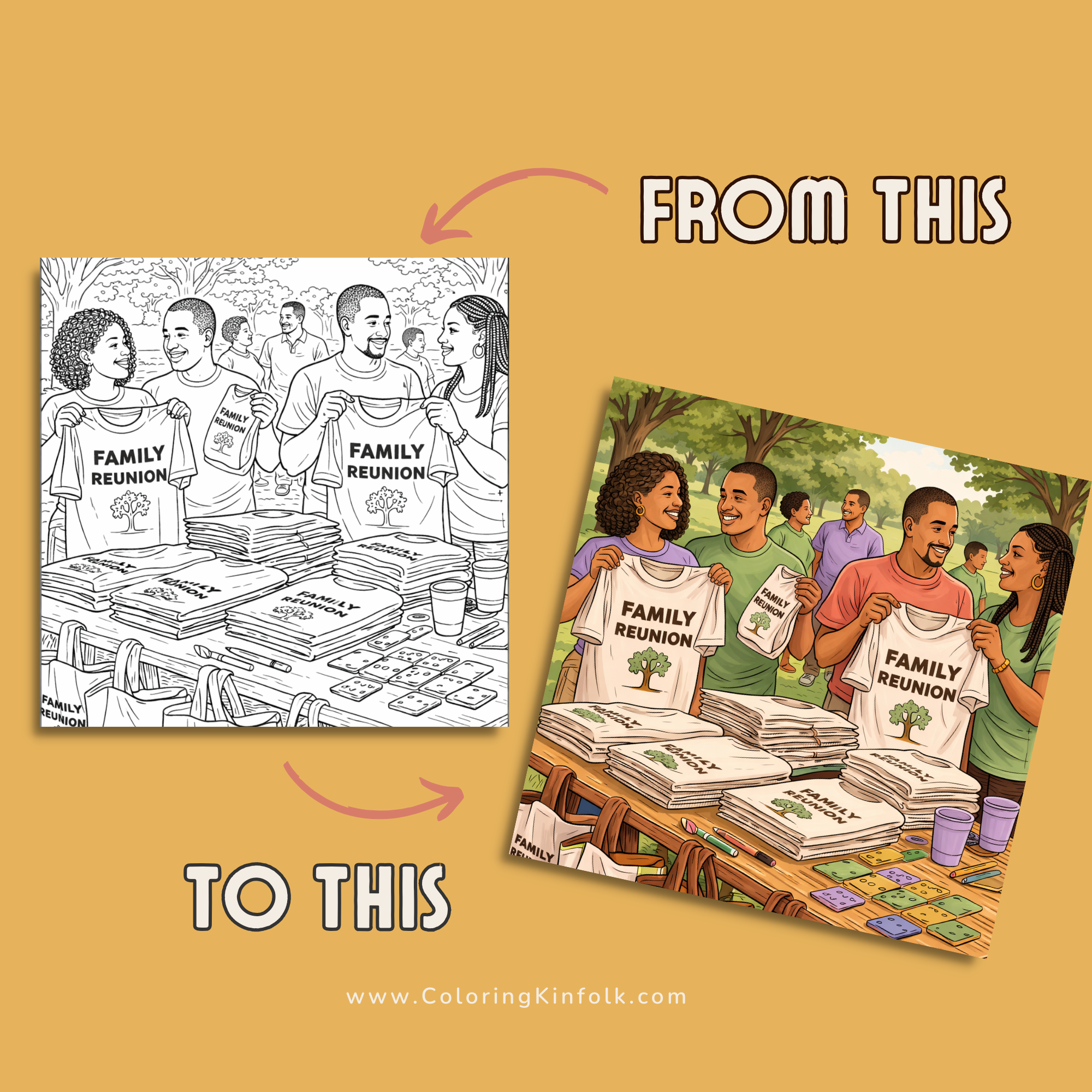
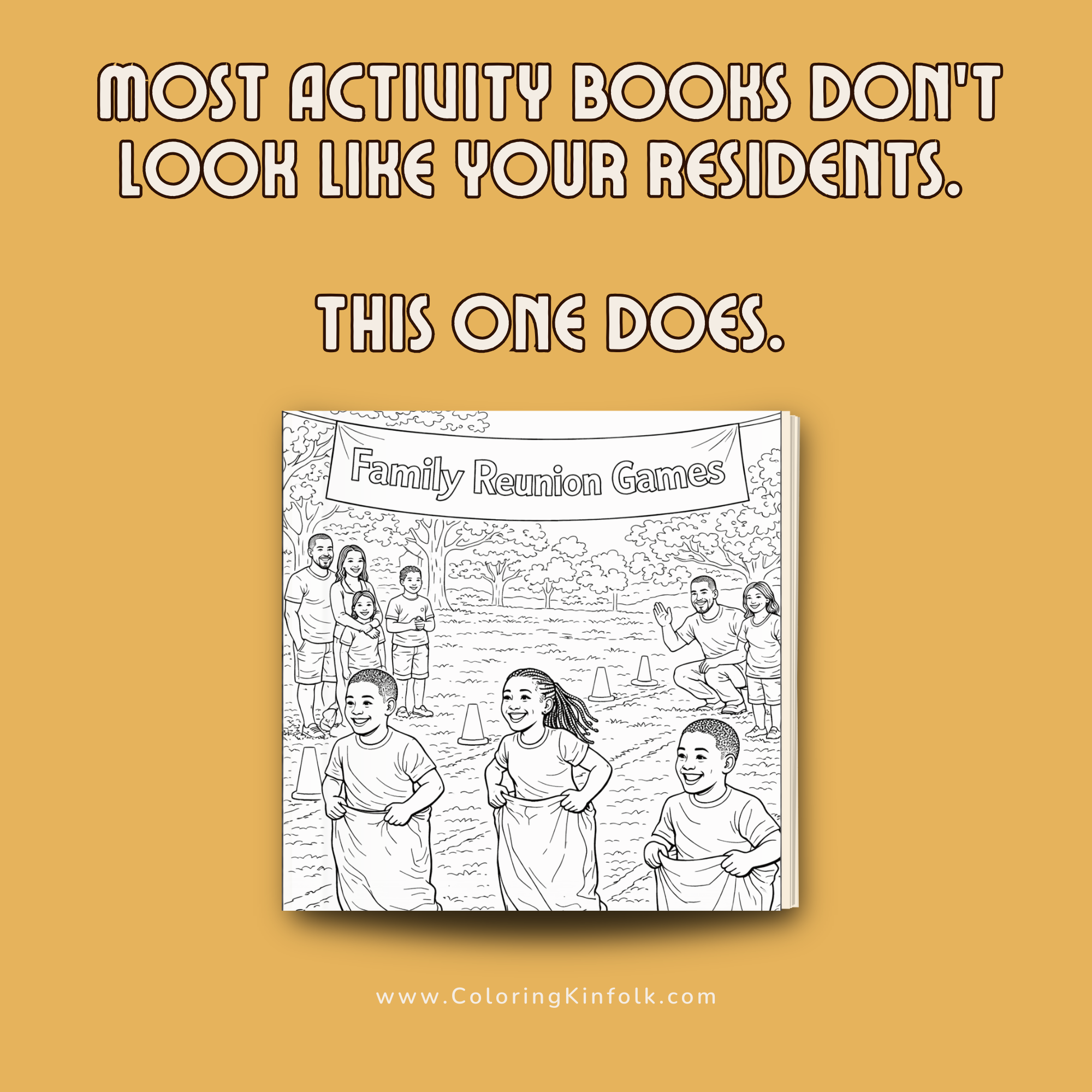
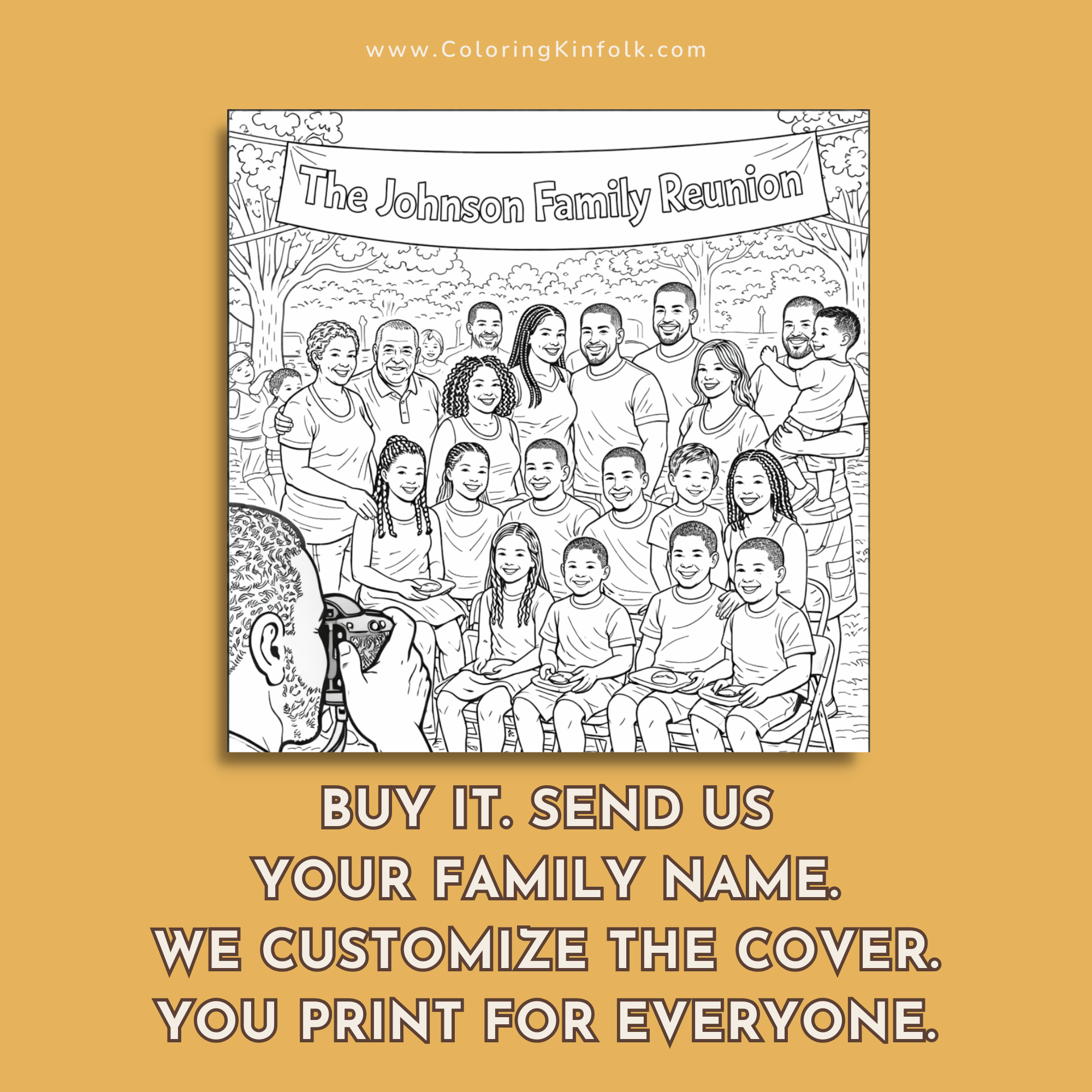
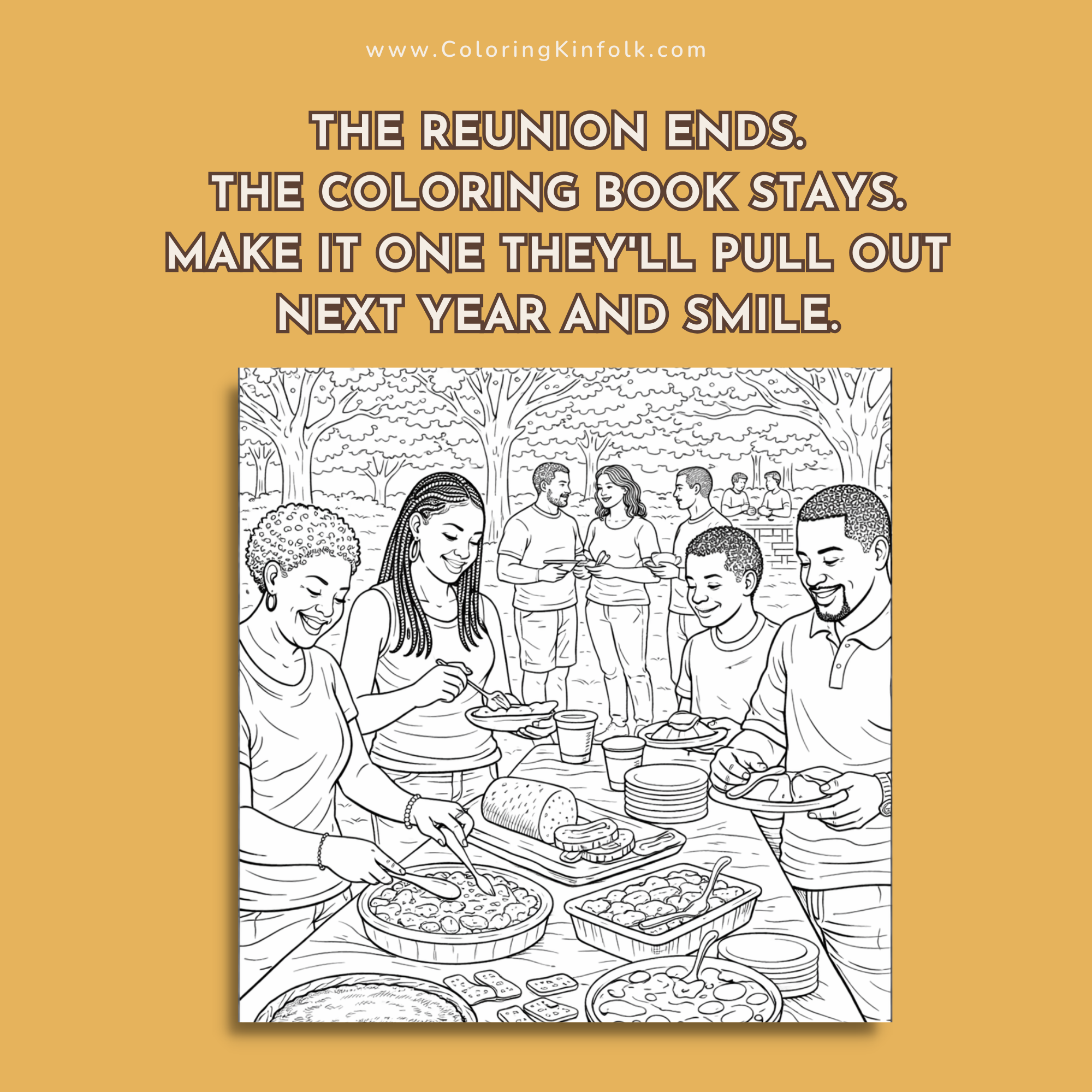
Coloring Kinfolk’s Family Reunion collection is designed exactly for this: 25+ pages of intergenerational Black family moments. Every page depicts multiple generations together, triggering “that’s just like our family” recognition.
Activity #2: Storytelling and Memory Sharing Circles
The Setup
Location: Shaded area with seating in circle or semi-circle. Visible but slightly separated from high-traffic areas.
Timing: Two scheduled 45-minute sessions during reunion. One mid-morning, one mid-afternoon. Give people multiple chances to participate.
Facilitation: Designate a family member as storyteller facilitator. Their job: ask prompting questions, keep time, gently redirect if stories run too long, make sure elders get priority speaking time.
How It Works
Round 1 (15 min): “Remember when…” stories: Open floor for favorite family memories. Elders go first. Each person gets 2-3 minutes.
Round 2 (15 min): “Did you know…” family history: Historical knowledge about family. Where did we come from? Who were our ancestors? What do we know about migration patterns, occupations, challenges overcome?
Round 3 (15 min): “Here’s what I learned…” wisdom sharing: Life lessons learned from family members. What did Grandma always say? What did Granddad teach you? This is cultural transmission in action.
Recording: Designate someone to record audio or video (with permission). This becomes family archive material. Transcribe key stories for family newsletter or archive.
Conversation Starters
Have these questions ready if stories slow down:
– What’s the funniest thing that ever happened at a family gathering?
– Who was the best cook in the family? What did they make?
– What family tradition should we make sure we pass down?
– What do you wish younger generations knew about our family?
– What’s changed the most about our family gatherings over the years?
RELATED: Why Creative Rituals Matter for Black Families
Activity #3: Family Tree and Heritage Board
The Family Tree Display
Pre-reunion prep: Create a large visual family tree on poster board or fabric banner. Include as many generations as you can document. Leave blank spaces for information gaps.
At the reunion: Display prominently. Provide markers and sticky notes. Encourage family members to fill in gaps, add information, correct errors. This becomes collaborative family history project.
For kids: Create a simplified “kid version” tree showing just 3-4 generations. Let kids find themselves, identify their grandparents and great-grandparents, add drawings.
The Heritage Board
Setup: Large cork board or foam board divided into sections: “Family Firsts” (first to graduate college, first to own home, first business owner), “Family Traditions,” “Family Recipes,” “Family Wisdom,” “Family Migrations.”
How it works: Provide index cards and pins. Anyone can contribute throughout the day. Elders write down family history. Middle generation adds memories. Kids contribute drawings or questions.
Post-reunion: Photograph completed board. Type up content. Include in family newsletter or create digital archive.
Activity #4: Cultural Keepsake Creation
Option A: Family Recipe Book Assembly
Pre-reunion: Ask family members to submit favorite family recipes with stories attached. “Grandma’s Mac and Cheese (the secret is…)” “Aunt May’s Sweet Potato Pie (she only made it for…)”
At reunion: Set up station where people can add handwritten recipe cards, share recipe stories, contribute to collaborative family cookbook.
Post-reunion: Compile and print. Sell to family members at cost or distribute as holiday gift.
Option B: Family Quilt Square Project
Setup: Provide plain fabric squares, fabric markers, stencils. Each family unit creates one square representing their branch of the family.
Creation: Draw family symbols, write names and dates, add meaningful images. Kids can help with their family’s square.
Post-reunion: Collect squares. Designate a family member to assemble into actual quilt (or pay someone to do it). Display at next year’s reunion.
Option C: Video Interview Booth
Setup: Quiet corner with simple backdrop, phone or camera on tripod, list of interview questions.
Process: Elders (and willing others) record 5-10 minute interviews answering: What do you want future generations to know? What was your childhood like? What’s your favorite family memory?
Post-reunion: Edit into family video archive. Share with family members. This is cultural inheritance preservation.
Complete Family Reunion Day Schedule
Setup starts 2 hours before reunion
10:00 AM – Noon: Arrival and Morning Activities
– Coloring station opens (runs all day)
– Family tree display set up for viewing and contribution
– Heritage board available for submissions
– Free mingling, greeting, catching up
Noon – 1:00 PM: Lunch
– Food served
– Eating and fellowship
– Coloring station remains available for those who want quieter activity
1:00 – 1:45 PM: First Storytelling Circle
– Scheduled memory sharing session
– Elders share family history and stories
– Recording for archive
1:45 – 3:00 PM: Free Activity Time
– Coloring station active
– Keepsake creation projects available
– Video interview booth open
– Yard games, kids’ activities, free socializing
3:00 – 3:45 PM: Second Storytelling Circle
– Different stories and participants from first session
– More intergenerational knowledge transfer
3:45 – 4:30 PM: Group Activities
– Family photo
– Acknowledgments and announcements
– Planning for next year
– Closing remarks from eldest family member
4:30 – 5:00 PM: Wrap-up and Farewell
– Distribution of take-home materials (completed coloring pages, recipe cards, etc.)
– Final goodbyes
– Cleanup
Budget Breakdown for 50-100 Family Members
Venue: Park pavilion rental ($75-150) or church fellowship hall ($50-100)
Food: Potluck style (minimal central cost) or catered ($300-600)
Activity materials:
– Family Reunion coloring book download: $20-30
– Printing coloring pages: $5-10
– Art supplies (crayons, markers, colored pencils): $40-60
– Family tree/heritage board materials: $25-40
– Keepsake project supplies: $30-50
– Name tags, folders, organizational supplies: $20-30
Optional expenses:
– T-shirts with family name/logo: $10-15 per shirt
– Professional photographer: $150-300
– Video equipment rental (if not using phones): $50-100
Total activity budget: $140-220 (excluding food and venue)
The coloring station is one of the most cost-effective activities with the highest engagement rate. One $20-30 download, print 50-60 pages ($5-10), provide supplies ($40-60). Total: $65-100 for an activity that runs all day and engages all ages.
RELATED: Nostalgia Isn’t a Backwards Step—It’s Your Anchor
Common Family Reunion Planning Mistakes
Mistake #1: Assuming Fellowship Will Happen Organically
The problem: You think people will naturally talk across generations and share stories. They don’t. Adults cluster by age cohort. Kids do kid things. Elders sit separately.
The solution: Create structured opportunities for intergenerational mixing. Coloring stations, storytelling circles, keepsake projects force different ages to interact.
Mistake #2: Only Planning for Kids
The problem: Bounce house, face painting, games—all kids’ activities. Adults have nothing to do but talk and eat.
The solution: Activities where all ages participate together. Coloring works for 4-year-olds and 84-year-olds. Memory sharing includes everyone. Keepsake creation is multi-generational.
Mistake #3: No Plan for Preserving What’s Shared
The problem: Great stories get told, then disappear. No one recorded. No one wrote down. Gone when elders pass.
The solution: Deliberate archiving. Record storytelling circles. Write down contributions to heritage board. Take photos of family tree with additions. Treat the reunion as heritage preservation opportunity.
Mistake #4: Over-Programming Every Minute
The problem: Scheduled activities every 30 minutes. No breathing room. Everyone’s exhausted by hour three.
The solution: Anchor activities that run continuously (coloring station, heritage board). Scheduled activities at key moments (storytelling circles, group photo). Lots of unstructured time for organic connection.
Making It Annual: Building Family Reunion Traditions
Year 1: Establish the structure. Coloring station, one storytelling circle, family tree display. Keep it simple. Gather feedback.
Year 2: Build on what worked. Add one new element (maybe keepsake project). Bring back coloring pages from Year 1 plus new ones. Show family tree with Year 1 additions.
Year 3+: Now it’s tradition. People expect the coloring station. Elders look forward to storytelling circle. Kids ask “Are we doing the coloring again?” The reunion becomes known for intergenerational connection, not just food and photos.
Creating Continuity
Family reunion archive box: Store materials year to year. Leftover coloring pages, conversation prompt cards, name tags, organizational supplies. Don’t reinvent every year.
Reunion newsletter: Post-event email or printed newsletter. Include stories shared, photos from reunion, updates on family tree, plans for next year. Keeps family connected between reunions.
Digital archive: Create shared Google Drive or Dropbox folder. Upload photos, videos, transcribed stories, updated family tree. Accessible to all family members year-round.
What Families Are Saying
“We’ve been having family reunions for 20 years but they always felt chaotic. Adding the coloring station changed everything. My 6-year-old sat next to her great-grandmother for an hour coloring and listening to stories. That never would have happened organically.”
— Reunion organizer, Johnson family, Atlanta
“The storytelling circle was powerful. We recorded it and I’ve listened to it three times since the reunion. My grandfather shared things I’d never heard before. We almost didn’t schedule it because we thought it would be ‘boring.’ It was the most meaningful part of the day.”
— Family member, Williams reunion, North Carolina
Materials That Make the Difference
Why Generic Coloring Books Don’t Work for Family Reunions
Generic coloring books—flowers, mandalas, animals—don’t trigger family memory. They’re pleasant time-fillers, not conversation catalysts.
Culturally specific Black family imagery does both: keeps hands busy AND prompts stories. A Sunday Dinner scene reminds Grandma of her mother’s table. A front porch scene triggers “Remember when we used to sit outside until dark?” A church gathering page prompts “Our church homecoming looked just like this.”
That’s the difference between activity and meaningful activity.
Coloring Kinfolk’s Family Reunion Collection
Designed specifically for Black family reunions: 25+ pages depicting intergenerational Black family moments. Every page shows multiple generations together—grandparents with grandchildren, extended family gatherings, cultural celebrations, everyday family life.
Themes include: Sunday Dinners with extended family, multi-generational kitchen scenes, front porch gatherings, church Sundays, family reunions and picnics, grandparents teaching grandchildren, family celebration moments.
Each page is designed to trigger “that’s just like our family” recognition and prompt storytelling. That’s not accident. That’s purpose-built design.
Final Thoughts: Reunions as Cultural Transmission
Family reunions used to be how cultural knowledge got passed down. Elders told stories. Middle generation absorbed them. Kids learned who they came from. That transfer happened organically because families lived closer, gathered more often, and had fewer competing demands for attention.
It doesn’t happen organically anymore. We have to structure it deliberately. Coloring stations that keep hands busy while mouths talk. Storytelling circles that create space for elder voices. Heritage boards that document what’s shared. Keepsake projects that turn attendance into participation.
These aren’t frivolous activities. They’re cultural inheritance preservation. They’re how we make sure the next generation knows where they came from, who shaped them, and what family means beyond DNA.
Your family reunion can be more than food and photos. It can be the moment your daughter hears her great-grandmother’s migration story. The afternoon your son learns why Sunday Dinners matter. The day your family’s history gets written down before it’s forgotten.
Plan intentionally. Create space for stories. Give people something meaningful to do together. That’s how reunions become traditions that matter.
Create Family Reunion Moments That Last Beyond the Day
Turn your family reunion into cultural transmission with intergenerational coloring activities that connect ages 3 to 93 while preserving family stories and heritage.
Coloring Kinfolk’s Family Reunion collection features 25+ pages of multi-generational Black family moments designed to trigger memory, prompt storytelling, and create keepsakes. Instant download. Unlimited printing for your reunion.
Leave a Reply