Activity Director Resources for Culturally Relevant Senior Programming
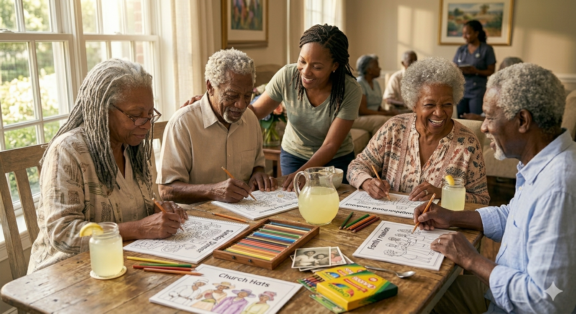
An activity director resource is any tool, guide, or material that helps life enrichment professionals plan, facilitate, and document meaningful engagement for older adults in care settings. For activity directors serving Black American elders, culturally specific resources, including scene-based coloring pages rooted in Black American life, provide programming that supports both resident engagement and person-centered care documentation.
The residents you serve did not live generic lives. They grew up at specific tables, in specific kitchens, on specific porches. They know the sound of a particular Sunday, the smell of a particular kitchen, the weight of a particular family reunion. When the activity cart rolls out, the question is not whether they will color. The question is whether the page in front of them will reach them.
The coloring is the excuse. The connection is the point.
— Coloring Kinfolk
Why Cultural Specificity Belongs in Your Programming Documentation
Person-centered care regulations, including those tied to CMS survey readiness and resident rights frameworks, require that activity programming reflect individual preferences, backgrounds, and cultural identities. That is not language for a brochure. It is a documentation standard.
An activity director who can demonstrate that programming materials were selected to reflect the specific cultural backgrounds of the resident population is ahead of the survey. Coloring Kinfolk’s scene-based materials are designed for exactly that documentation argument: culturally grounded, identity-affirming, and built on reminiscence therapy principles with published research support.
How To Use Coloring Kinfolk Materials in a Group Session
No prep-heavy facilitation required. Begin by displaying the page before distributing it. Let residents look. Name what they see. A Sunday Dinner table. A pot of collard greens. A porch screen door. Ask an open question: did you cook this? Who sat at your table? What was always on yours?
Then color. Let the conversation follow the coloring, or let the silence be enough. Both are valid outcomes. The page is the entry point, not the destination. After the session, note which scenes generated the most conversation or longest engagement in your activity documentation. That data is clinically useful and supports individualized care planning.
Resources Available for Activity Directors
- Activity Director Resource Guide: Download the Activity Director Resource Guide for programming frameworks, facilitation guides, and cultural activity calendars built for memory care settings.
- Institutional licenses: Licenses start at $197 for a single facility and include scene-based coloring pages, the Cultural Memory Companion with scene-specific memory prompts, and the Staff Implementation Guide. Multi-facility networks are licensed at $497. Sample pages are available before you commit.
- Shop and free pages: Individual printable titles are at the shop. Download free sample pages before committing to a license.
Related Reading
- Memory Care Coloring Resources for Facilities and Families
- Reminiscence Therapy and Memory Preservation Resources
- Culturally Relevant Senior Activities for Black American Elders
Frequently Asked Questions
What Is a Culturally Relevant Senior Activity?
A culturally relevant senior activity reflects the specific cultural background, lived experience, and autobiographical memory of the person participating. For Black American elders, culturally relevant programming includes imagery and scene settings drawn from Black American life, rather than generic or ethnically neutral materials.
How Do Coloring Kinfolk Materials Support CMS Survey Readiness?
Person-centered care standards require that activity programming reflect individual resident preferences and cultural backgrounds. Scene-based coloring materials rooted in culturally specific imagery provide a documentable, dignity-affirming activity option. Coloring Kinfolk materials include scene-specific memory prompts that can be referenced directly in activity notes.
Are These Materials Appropriate for Residents With Moderate to Severe Dementia?
Yes. Large print format and bold line art accommodate declining fine motor control and visual acuity. Scene-based imagery activates long-term autobiographical memory, which persists longer than short-term recall in most dementia presentations. No verbal communication or prior experience is required to participate.
What Is the Cost for a Facility License?
Single-facility licenses are $197 and include 10 curated scene-based pages, facility-wide print rights, the Cultural Memory Companion, and the Staff Implementation Guide. Multi-facility network licenses are $497. A $1 sampler is available before you commit. Visit the institutional licensing page for details.
Request a sample set. Bring one session to your residents this week and see what happens when the page on the table feels like home.
The coloring is the excuse. The connection is the point.