Reminiscence Therapy and Memory Preservation Resources
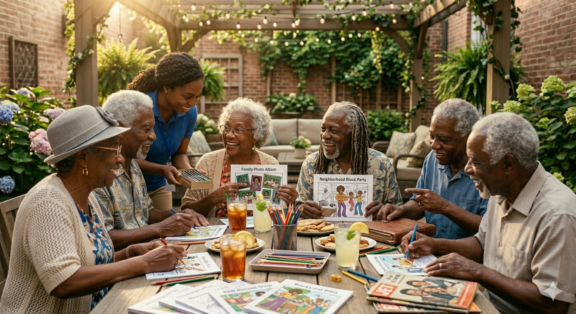
Reminiscence therapy is a structured approach that uses familiar images, sounds, and objects to stimulate long-term memory and support emotional wellbeing in older adults, particularly those living with dementia. Research supports its use for reducing depression, improving mood, and increasing social engagement. For Black American elders, culturally specific imagery, including Sunday Dinner scenes, Grandma’s kitchen, and the front porch, serves as more powerful memory anchors than generic materials because it carries autobiographical resonance specific to their lived experience.
Reminiscence therapy was developed in the 1960s by psychiatrist Robert Butler, who recognized that life review was not just idle nostalgia but a clinically meaningful process for older adults. It uses structured prompts, photographs, music, objects, and imagery to help people access long-term memory, which persists far longer than short-term recall in most dementia presentations.
Long-term memory does not forget the front porch. It remembers everything that ever happened there.
— Coloring Kinfolk
Why Cultural Specificity Makes Reminiscence Therapy More Effective
Generic imagery activates generic memory. A photograph of any kitchen might produce mild recognition. A photograph of the kind of kitchen your grandmother actually had, with the particular cast iron skillet, the particular placement of the window, the particular quality of light on a Sunday morning, that reaches somewhere specific.
Research on reminiscence therapy consistently shows that personally meaningful stimuli produce stronger memory activation than neutral stimuli. For Black American elders, that means scenes rooted in Black American life, not stock images of a generic family dinner, but a table set the way that table was set, with the food that was on it, in a room that looked like theirs. Cultural specificity is not decoration. It is therapeutic mechanism.
Memory Preservation for Families
Reminiscence therapy happens in clinical settings. Memory preservation happens at the kitchen table, on a Sunday afternoon, before the stories are gone.
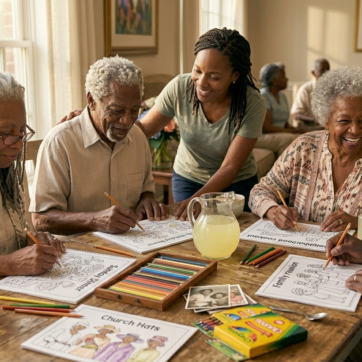
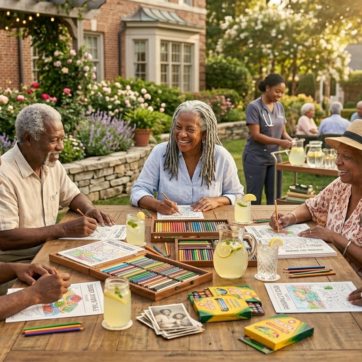
For families, the work of preservation is not complicated, but it is urgent. The Sunday Dinner rituals, the front porch traditions, the particular recipes that were never written down, these are not small losses when they go. Coloring Kinfolk offers families a way into this conversation. The custom coloring book, built around your specific family’s scenes, is one form of preservation. The coloring is the excuse. The stories that come out during the session are the archive.
Resources on This Hub
- Activity Director Resource Guide — programming frameworks and facilitation tools for care settings.
- Free sample coloring pages — download and try a session before committing to a license.
- Custom coloring book — commission pages built around your specific family’s memories, starting at $75.
Related Reading
- Memory Care Coloring Resources for Facilities and Families
- Activity Director Resources for Culturally Relevant Senior Programming
- Black Family Cultural Memory: Coloring Books Rooted in Black American Life
- Custom Coloring Books: Your Family’s Scenes, Your Book
Frequently Asked Questions
What Is the Difference Between Reminiscence Therapy and Life Review?
Life review is a broader psychological process in which a person reflects on their life as a whole to find meaning. Reminiscence therapy is a structured activity-based approach that uses external prompts to stimulate specific memories and support social engagement and emotional wellbeing. Both are used in elder care, but reminiscence therapy is more activity-program focused.
Can Reminiscence Therapy Be Done at Home by Family Members?
Yes. Structured reminiscence does not require a clinical setting or a licensed therapist to be beneficial. Families can use photographs, music, objects from the person’s past, or scene-based coloring pages as prompts for conversation and memory activation. The key is familiar, culturally specific imagery and unhurried time.
Does Coloring Kinfolk Offer Specific Tools for Reminiscence Therapy?
Yes. The Cultural Memory Companion, included with institutional licenses, provides scene-specific memory prompts for each page set. Individual families can download free coloring pages and use them with their own conversation prompts. The custom coloring book option allows families to commission pages built around specific personal and family memories.
Is There Research Supporting Reminiscence Therapy for Dementia?
Yes. Multiple peer-reviewed studies support reminiscence therapy as a non-pharmacological intervention for dementia, with documented benefits including reduced depression, improved mood, increased social engagement, and enhanced quality of life. A Cochrane Review and studies published in the International Journal of Geriatric Psychiatry have examined its efficacy.
Download free memory prompt coloring pages and try one session this week. See what comes back when the page feels familiar.
Long-term memory does not forget the front porch. It remembers everything that ever happened there.