You’re planning a Juneteenth celebration for your church, school, or community organization. You know Juneteenth matters. You want to honor it authentically. But you’re running into the same problems every event coordinator faces: limited budget, limited time, limited access to culturally authentic materials that you can actually use legally for group activities.
Here’s the comprehensive institutional guide to Juneteenth event planning, including the solutions to the problems nobody talks about.
The Pain Points Nobody Mentions (Until It’s Too Late)
Let’s be honest about what you’re actually dealing with:
Pain Point #1: The Cultural Authenticity Problem
You want to honor Juneteenth respectfully. You search for “Juneteenth activities” and find generic clipart, stock photos with brown skin tones, and materials that feel performative rather than authentic. You know your community deserves better, but you don’t know where to find it.
Why this matters: Your congregation, students, or community members can tell the difference between authentic cultural representation and surface-level diversity theater. Generic materials undermine the very purpose of the celebration.
Pain Point #2: The Licensing Nightmare
You find a beautiful Juneteenth coloring book on Etsy for $12. Perfect! You buy it, download it, print 75 copies for your event. Congratulations: you just committed copyright infringement.
Consumer downloads are for personal use only. Reproducing them for institutional group activities is illegal, even if you paid for the original. But nobody tells you this until it’s too late.
Why this matters: Your organization’s legal compliance and ethical integrity are at stake. Plus, you’re undermining the creators who made the materials you needed.
Pain Point #3: The Age Range Challenge
Your event serves everyone from toddlers to great-grandmothers. Most Juneteenth materials are designed for one narrow age group. You end up with activities that work for some people and bore or overwhelm others.
Why this matters: Juneteenth is inherently intergenerational. Materials that can’t span ages miss the entire point of community celebration.
Pain Point #4: The Budget Constraint
Your church budget for Juneteenth: $200. Maybe $300 if someone writes a check. You need materials for 100+ people. The math doesn’t work with per-person pricing.
Why this matters: Cultural celebration shouldn’t be a luxury good. But without institutional pricing models, that’s exactly what it becomes.
RELATED: Why Black Family Coloring Pages Keep Our Stories Alive
The Solution: Purpose-Built Institutional Materials
Here’s what actually works for organizations planning Juneteenth celebrations:
Institutional Bulk Licensing
One purchase. Unlimited printing for your organization. No per-person fees. No copyright concerns. No scrambling to find more materials mid-event.
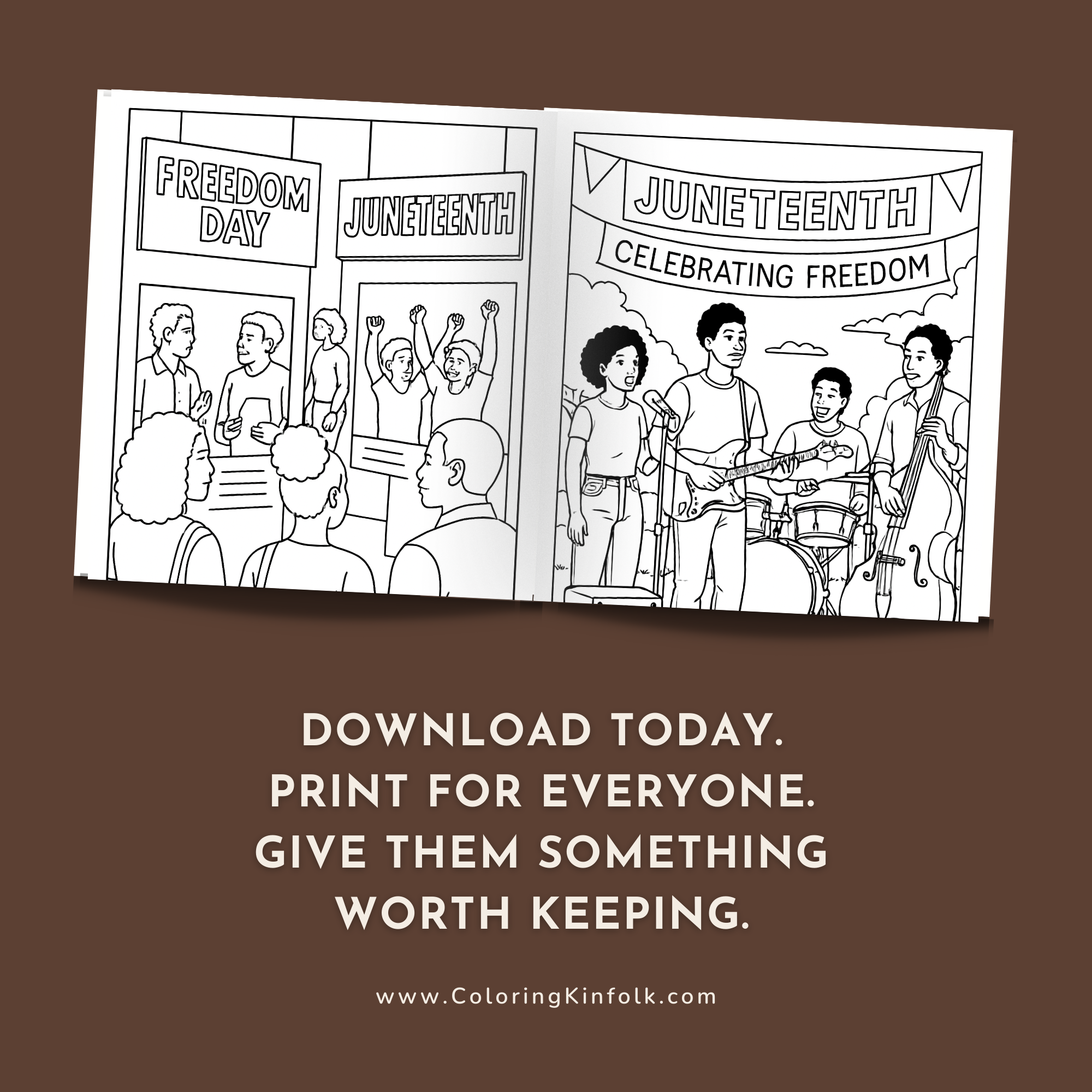
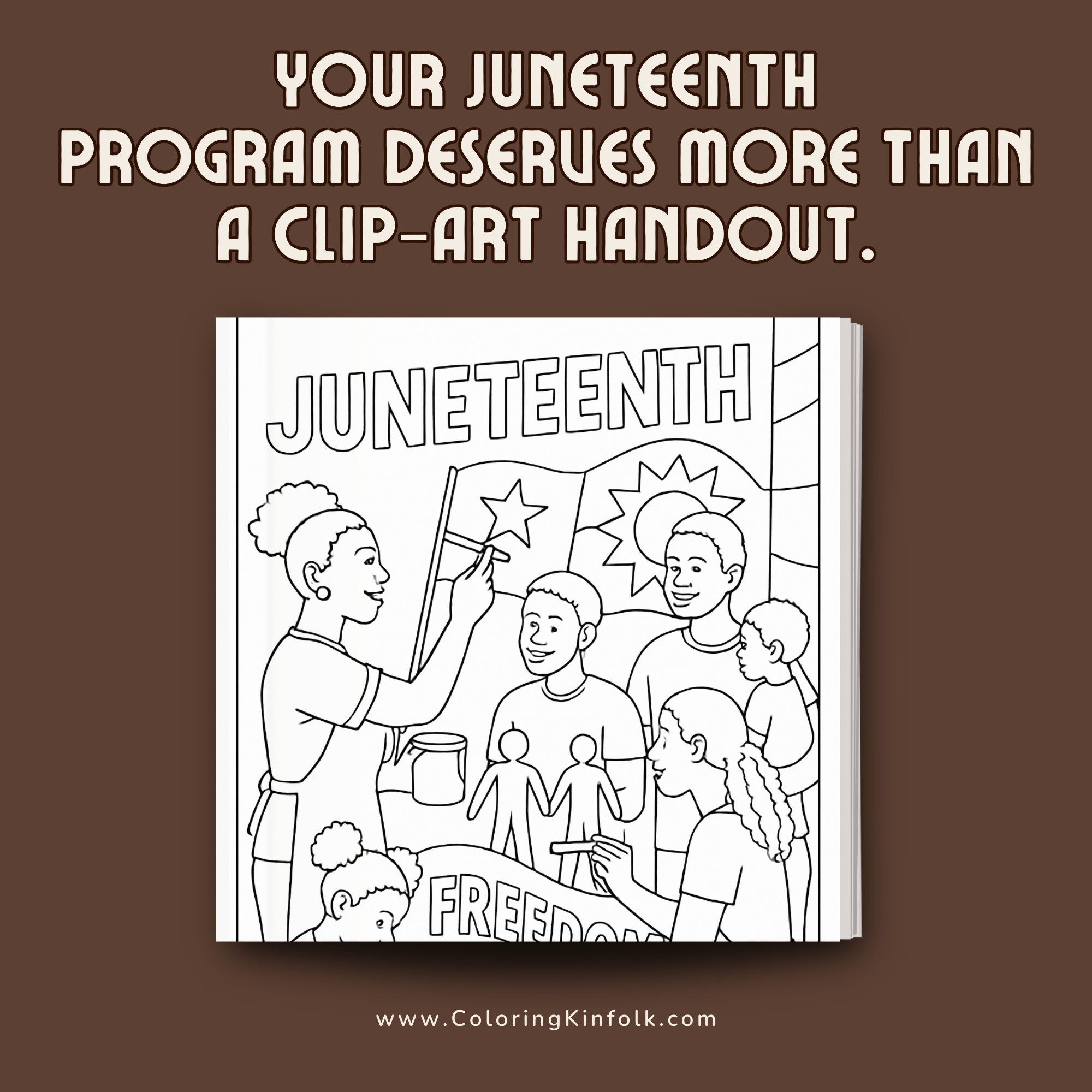
Coloring Kinfolk’s Juneteenth institutional license ($197) includes 25+ culturally authentic celebration pages, conversation prompts for all ages, educational context materials, and unlimited print rights for your church, school, or organization.
The math: $197 ÷ 100 participants = $1.97 per person. That’s less than a single coloring book at retail. And you can use it year after year.
Culturally Specific, Not Generic Diverse
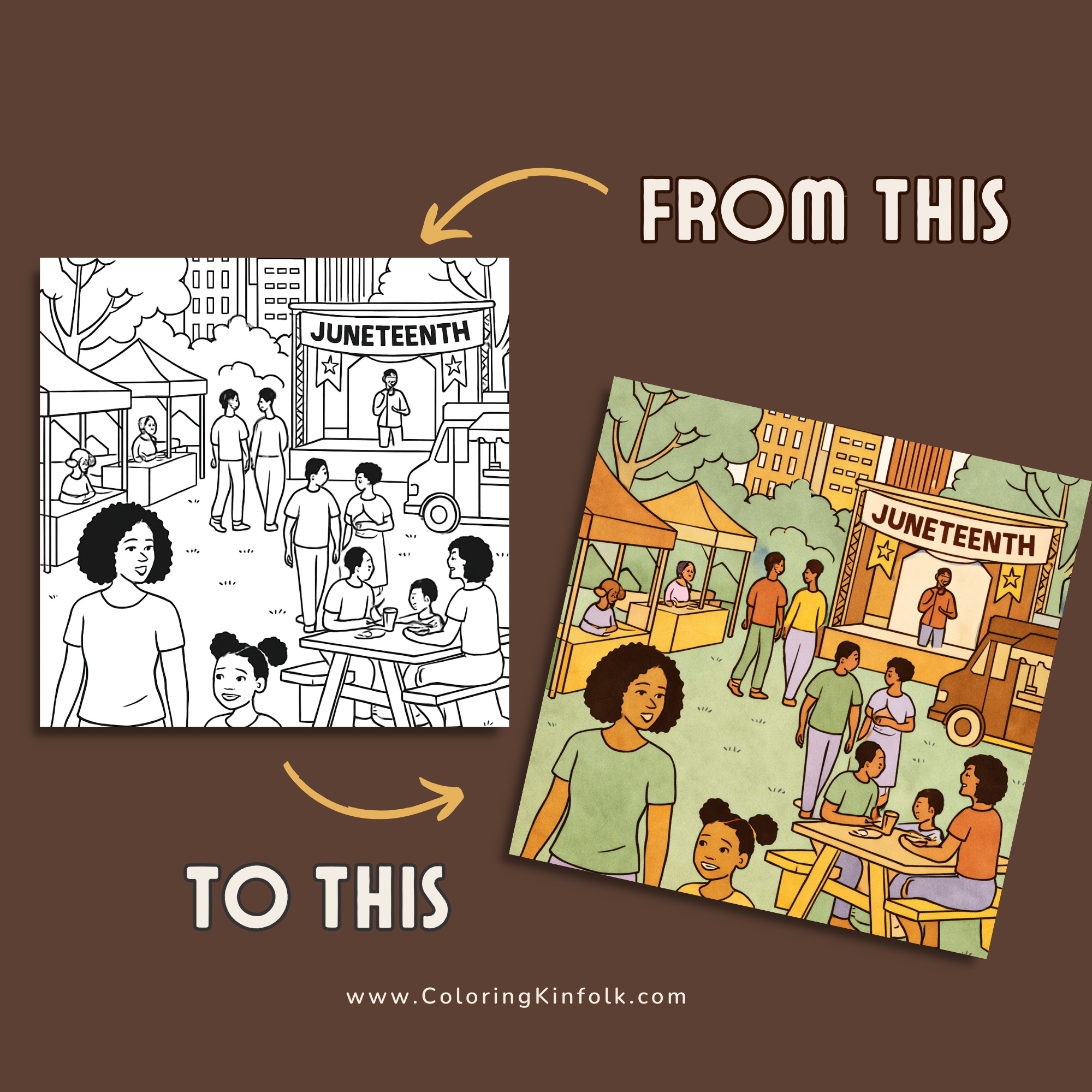
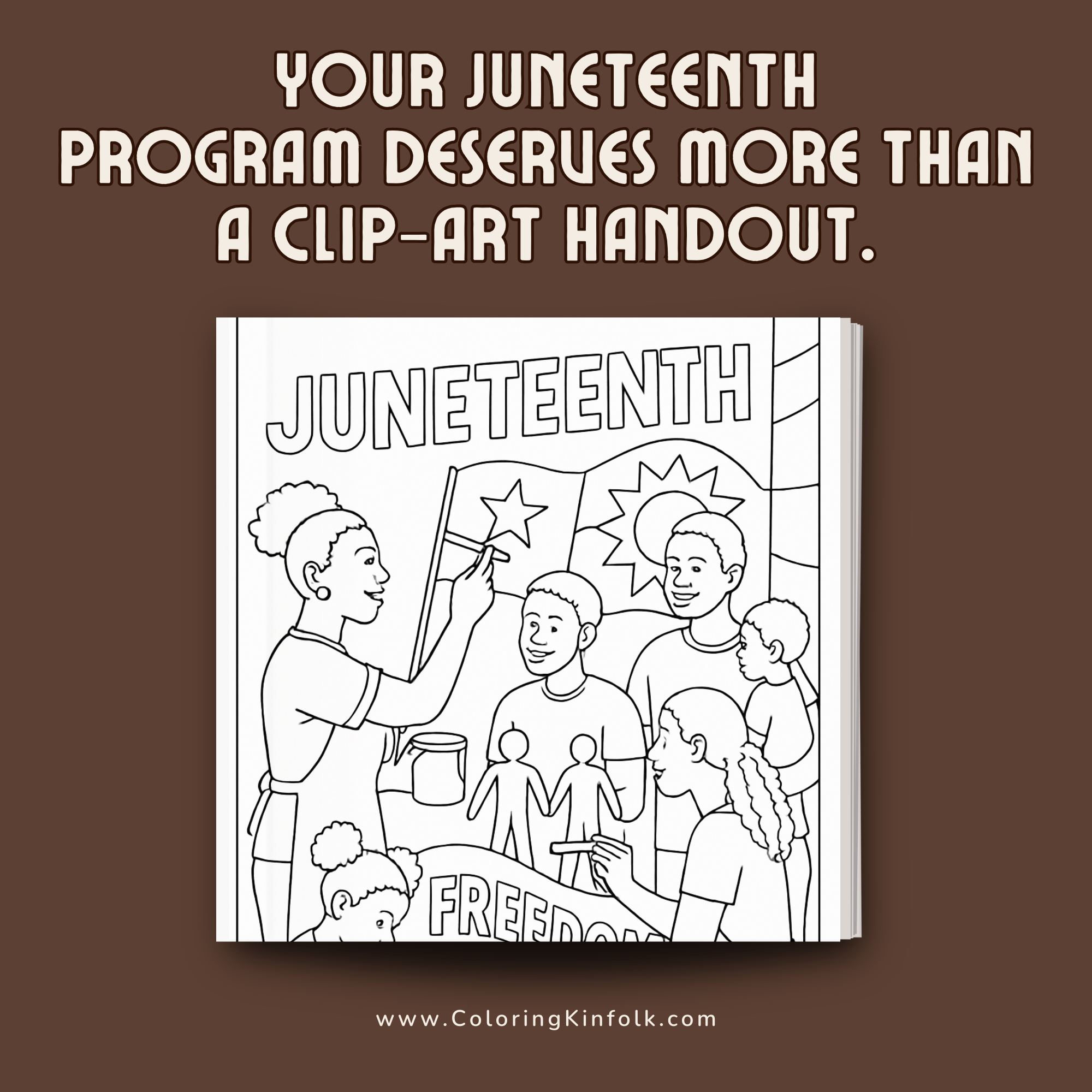
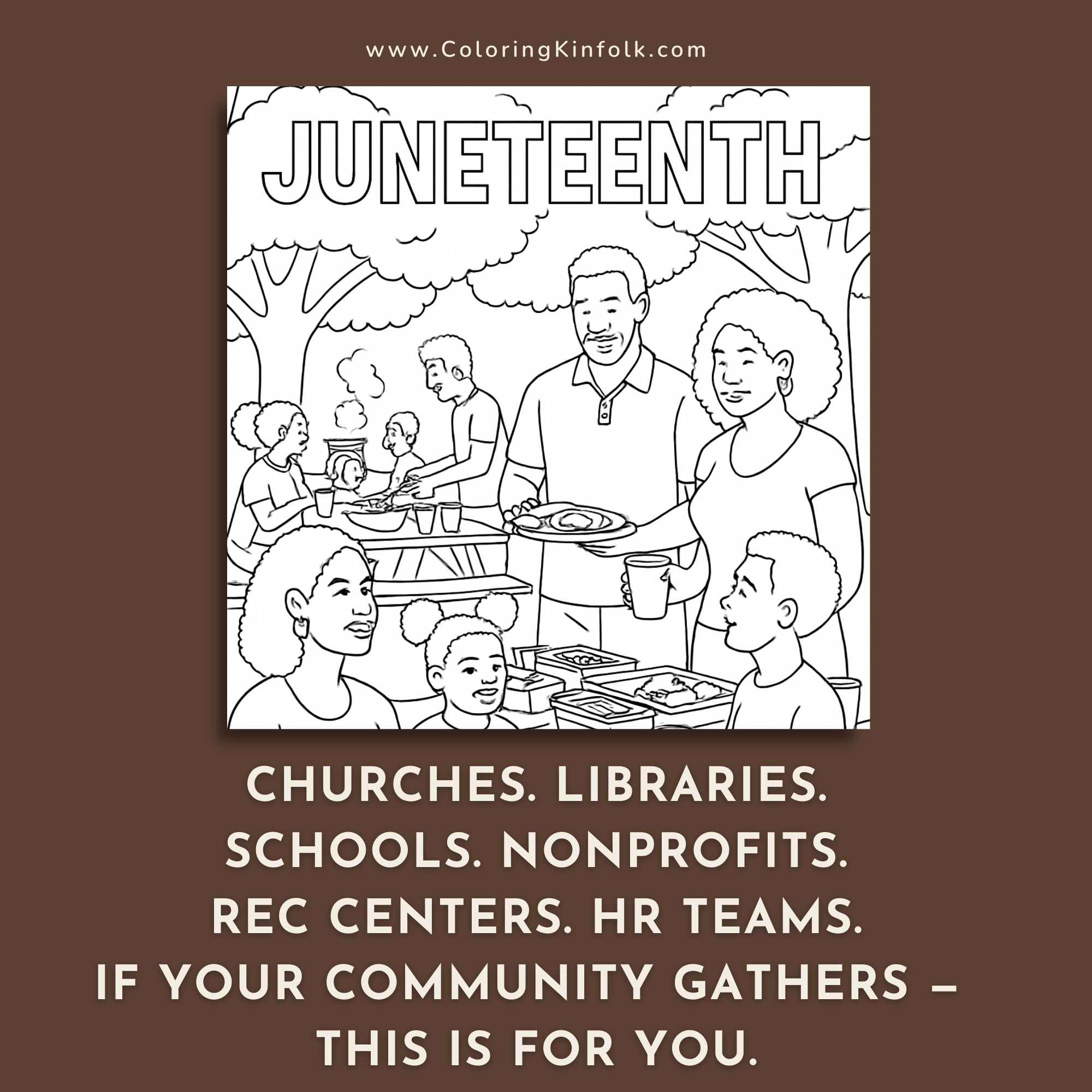
Every page depicts recognizable scenes from Black American Juneteenth celebrations: families gathering, community barbecues, church services, children playing, elders sharing stories, freedom moments.
This isn’t brown-skinned clipart. This is cultural specificity: the food on the table, the way people gather, the church hats, the barbecue pit, the intergenerational dynamics. Details that say: this is our celebration, not a generic diversity moment.
All-Ages Accessibility
Simple line art for young children. More detailed scenes for teens and adults. Conversation prompts that work across generations. One collection, entire age spectrum.
Grandmothers and grandchildren can color side-by-side using the same materials. That’s not just cost-effective. That’s culturally appropriate. Juneteenth celebrations are intergenerational by design.
Complete Juneteenth Event Planning Guide (By Venue Type)
For Churches: Fellowship Hall Celebration
Setup (2 hours before):
Transform your fellowship hall into a Juneteenth celebration space:
**Coloring station:** Set up 3-4 tables with chairs. Print 100+ copies of Juneteenth coloring pages (your institutional license covers this). Provide crayons, colored pencils, markers. Add conversation prompt cards at each table.
**Food table:** Traditional Juneteenth foods. Enlist congregation members to bring red drinks, barbecue, potato salad, watermelon, red velvet cake. Explain the significance of red foods.
**Testimony corner:** Designated space for elders to share freedom stories. Provide seating. Consider recording these for your church archive.
**Children’s area:** Age-appropriate Juneteenth books, freedom songs playlist, space for movement and play.
Program flow (2-3 hours):
**Opening (15 min):** Brief historical context from pulpit. Keep it accessible for all ages. Focus on freedom and celebration, not just trauma.
**Coloring and fellowship (45 min):** Everyone moves to tables. Color, eat, talk. Elders share stories. Kids ask questions. This is the core of the event.
**Music and movement (20 min):** Freedom songs. Let children lead. Encourage participation across ages.
**Closing reflection (10 min):** Circle up. Each person shares one word: what does freedom mean to you? Or: what are you grateful for today?
**Continued fellowship (flexible):** Let people stay, color, eat, connect. Don’t rush the community time.
Budget breakdown:
– Institutional coloring license: $197 (one-time, reusable)
– Art supplies (crayons, markers): $50-75
– Food (potluck style): minimal church cost
– Decorations (red, white, blue): $25-50
Total: $272-322 for 100+ participants
For Schools: Educational Assembly + Classroom Activities
Assembly (45 minutes):
Age-appropriate historical presentation. Use visual aids. Keep it interactive. Focus on freedom and celebration.
**Elementary:** Simple timeline. Story format. Emphasize celebration and family.
**Middle school:** More historical context. Why was emancipation delayed? What does this teach us about freedom and justice?
**High school:** Critical analysis. Contemporary connections. What does Juneteenth mean today?
Classroom follow-up (per grade level):
**K-2:** Coloring celebration scenes. Simple discussion: what is freedom? What do we celebrate?
**3-5:** Coloring + writing. “Freedom means…” sentences. Create class Juneteenth book.
**6-8:** Detailed coloring pages with historical context. Research family history. Where were your ancestors in 1865?
**9-12:** Creative projects. Freedom poetry. Documentary analysis. Community service linked to Juneteenth themes.
Teacher support:
Provide teachers with: printed coloring pages for entire class (your license covers this), conversation prompt guides, age-appropriate historical context sheets, suggested discussion questions.
Don’t expect teachers to figure it out themselves. Give them a complete, ready-to-use packet.
Budget note for schools:
One institutional license covers your entire school, all grades, all classrooms. That’s 500+ students for $197. The per-student cost is negligible.
RELATED: Why Creative Rituals Matter for Black Families
For Community Centers: Block Party Celebration
Outdoor setup (ideal for June weather):
**Coloring tent:** Shaded area with tables. Provide clipboards for kids who want to walk and color. Have extra supplies (crayons break, markers dry out).
**Food vendors or potluck:** Traditional Juneteenth foods. If budget allows, hire Black-owned food vendors. If not, organize community potluck.
**Music stage:** Live music if possible. Playlist of freedom songs if not. Keep it going all day.
**Kids zone:** Separate area for under-5s. Simpler activities. Closer supervision.
**Elder seating:** Comfortable chairs in shade. Elders shouldn’t have to stand or sit on the ground. Honor them properly.
Flow for drop-in events (4-6 hours):
People come and go. That’s fine. Make sure coloring station is staffed continuously. Someone should always be available to explain the significance, answer questions, facilitate conversations.
Don’t program every minute. Let community gather organically. The coloring station gives people something to do while they talk, reconnect, and celebrate.
Volunteer coordination:
You need: coloring station attendants (2-3 people rotating), food coordinators, music manager, kids zone supervisor, elder care team, setup/cleanup crew.
Don’t try to do this alone. Delegate. Many people want to help; they just need clear roles.
Common Institutional Planning Mistakes (And How to Avoid Them)
Mistake #1: Overcomplicated Programming
You plan a full day with speakers, performances, workshops, activities every 15 minutes. By hour three, everyone’s exhausted and nothing feels celebratory.
Better approach: Simple core activities. Lots of unstructured time for fellowship. Juneteenth is about community, not productivity.
Mistake #2: Trauma-Centered Content
Your program focuses heavily on slavery, suffering, and oppression. Minimal time on celebration. People leave feeling heavy, not uplifted.
Better approach: Lead with celebration. Add historical context as needed. Remember: Juneteenth was celebrated with joy by formerly enslaved people. Honor their choice.
Mistake #3: Last-Minute Planning
It’s June 10th. Juneteenth is in 9 days. You’re scrambling for materials, volunteers, and venue space. Everything feels rushed and chaotic.
Better approach: Start planning in April or May. Secure venue, order materials, recruit volunteers early. Give people time to prepare.
Mistake #4: No Cultural Input
Your planning committee has no Black members, or Black members’ input is sought only after major decisions are made. The event feels inauthentic because it is.
Better approach: Center Black voices from the beginning. If your organization lacks Black leadership, partner with Black-led organizations. Listen more than you talk.
Mistake #5: One-and-Done Approach
You celebrate Juneteenth this year. Next year, nothing. The event becomes a checkbox, not a tradition.
Better approach: Make it annual. Build on each year. Create continuity. Culture is built through repetition, not one-time events.
Why Coloring Stations Work So Well for Institutional Events
You might think: coloring seems simple. Maybe too simple for a significant historical celebration. But here’s why it works:
Universal Accessibility
A 4-year-old can color. A 94-year-old can color. Limited English speakers can participate. People with various abilities can engage. No special skills required.
Conversation Catalyst
Coloring keeps hands busy while mouths talk. The activity creates natural pauses for questions, stories, and reflection. It’s not silent; it’s conversational.
Cultural Transmission
When elders and children color the same scenes side-by-side, cultural knowledge passes down organically. “This reminds me of…” becomes “Tell me about…” The coloring page is just the excuse for intergenerational dialogue.
Keepsake Creation
People take their colored pages home. They hang them on refrigerators. They remember. Physical artifacts create lasting impressions in ways verbal presentations don’t.
Scalable and Budget-Friendly
One institutional license. Unlimited printing. Works for 50 people or 500. No per-person fees. No last-minute supply runs.
The Institutional Licensing Model Explained
Here’s exactly what you get with Coloring Kinfolk’s Juneteenth institutional license:
Materials included:
– 25+ Juneteenth celebration coloring pages (culturally authentic, joy-centered)
– Conversation prompt cards for facilitating dialogue
– Historical context sheets (age-appropriate versions for K-2, 3-5, 6-8, 9-12, adults)
– Activity guide for event coordinators
– Suggested program flows for different venue types
Print rights:
– Unlimited printing within your organization
– Use for classes, events, programs throughout the year
– Reusable year after year
– No per-person or per-event fees
Delivery:
– Instant digital download (perfect for last-minute planners)
– High-resolution PDFs optimized for printing
– Clear printing instructions included
Investment: $197 one-time purchase**
Compare to alternatives: hiring a cultural consultant ($500+), custom materials design ($1000+), per-person activity kits ($5-10 × number of participants). Institutional licensing is purpose-built for organizations.
RELATED: 5 Ways Coloring Books Bring Black Families Together
Beyond Coloring: Complementary Activities That Work
Coloring stations are the anchor activity. Add these to round out your program:
Freedom wall: Large paper or poster board. Prompt: “Freedom means…” People write/draw responses throughout event.
Story circle: Designated time for elders to share memories, family stories, or reflections on freedom.
Music component: Freedom songs, gospel, jazz. Live if possible, recorded if not.
Food as education: Explain significance of traditional Juneteenth foods. Red drinks, barbecue, specific dishes. Food is culture.
Photo station: Juneteenth backdrop. Let people take photos. Share on social media. Amplify the celebration beyond your walls.
Take-home packets: Coloring pages, historical info sheets, resource lists. Extend learning beyond the event.
Making It Sustainable: Year-Over-Year Growth
Don’t plan a one-time event. Build a tradition:
Year 1: Focus on getting it done. Simple program. Coloring station. Food. Music. Gather feedback.
Year 2: Refine based on feedback. Add one new element. Maybe invite a speaker or add a service component. Build on what worked.
Year 3+: By now it’s a tradition. People expect it. Ask for community input: what should we add? How can we deepen this?
Your institutional license works year after year. Print new copies annually. The materials don’t expire. The tradition grows.
Final Thoughts: Cultural Celebration Requires Cultural Authenticity
You can’t honor Juneteenth with generic materials. Your community deserves better than clipart with brown skin tones. Cultural celebration requires cultural specificity.
Institutional bulk licensing solves the three biggest problems event coordinators face: cultural authenticity (purpose-built materials rooted in Black American celebration traditions), legal compliance (explicit group use rights, not consumer products being misused), and budget constraints (one purchase, unlimited use, year after year).
Juneteenth is worth celebrating well. Your church, school, or organization can do this right. The materials exist. The model works. The investment is manageable.
Start planning now. Don’t wait until June 10th. Give yourself time to do this properly. Your community deserves a celebration that honors freedom with the depth and joy it warrants.
Institutional Solution: Everything You Need for Culturally Authentic Juneteenth Programming
Stop scrambling for materials. Stop worrying about copyright. Stop settling for generic diversity content. Get purpose-built institutional resources designed specifically for churches, schools, and community organizations.
Coloring Kinfolk’s Juneteenth institutional license ($197) includes 25+ culturally authentic celebration pages, conversation prompts, educational context materials, and unlimited print rights. One purchase, unlimited participants, reusable year after year.
Leave a Reply