If you’re an activity director, recreation therapist, or memory care coordinator, you’ve probably been told that “engagement” and “meaningful activity” matter for people with dementia. But what does the research actually say about which activities work best? And why does cultural specificity keep coming up in the literature on reminiscence therapy?
Here’s what the evidence shows about memory care coloring programs, and why most facilities are still using the wrong materials.
The Research Foundation: Why Reminiscence Therapy Works
Reminiscence therapy is one of the most widely studied non-pharmacological interventions for dementia and cognitive decline. A Cochrane Database systematic review found measurable improvements in quality of life, cognition, and depression scores among people with dementia. The key phrase: meaningful stimuli, which means culturally specific ones.
But here’s the problem: the market for memory care coloring books is growing, yet available products remain almost entirely generic. Geometric patterns. Abstract designs. Generic “multicultural” imagery that simply changes skin tone without changing cultural context.
The research is clear: specificity matters. But most vendors haven’t caught up yet.
RELATED: Why Coloring Grandma’s House Feels Like Therapy You Can Hold in Your Hands
What ‘Culturally Familiar’ Actually Means in Practice
For Black American elders who grew up in the mid-20th century South or urban communities in the North, culturally familiar imagery includes specific scenes, not broad categories:
Domestic Scenes
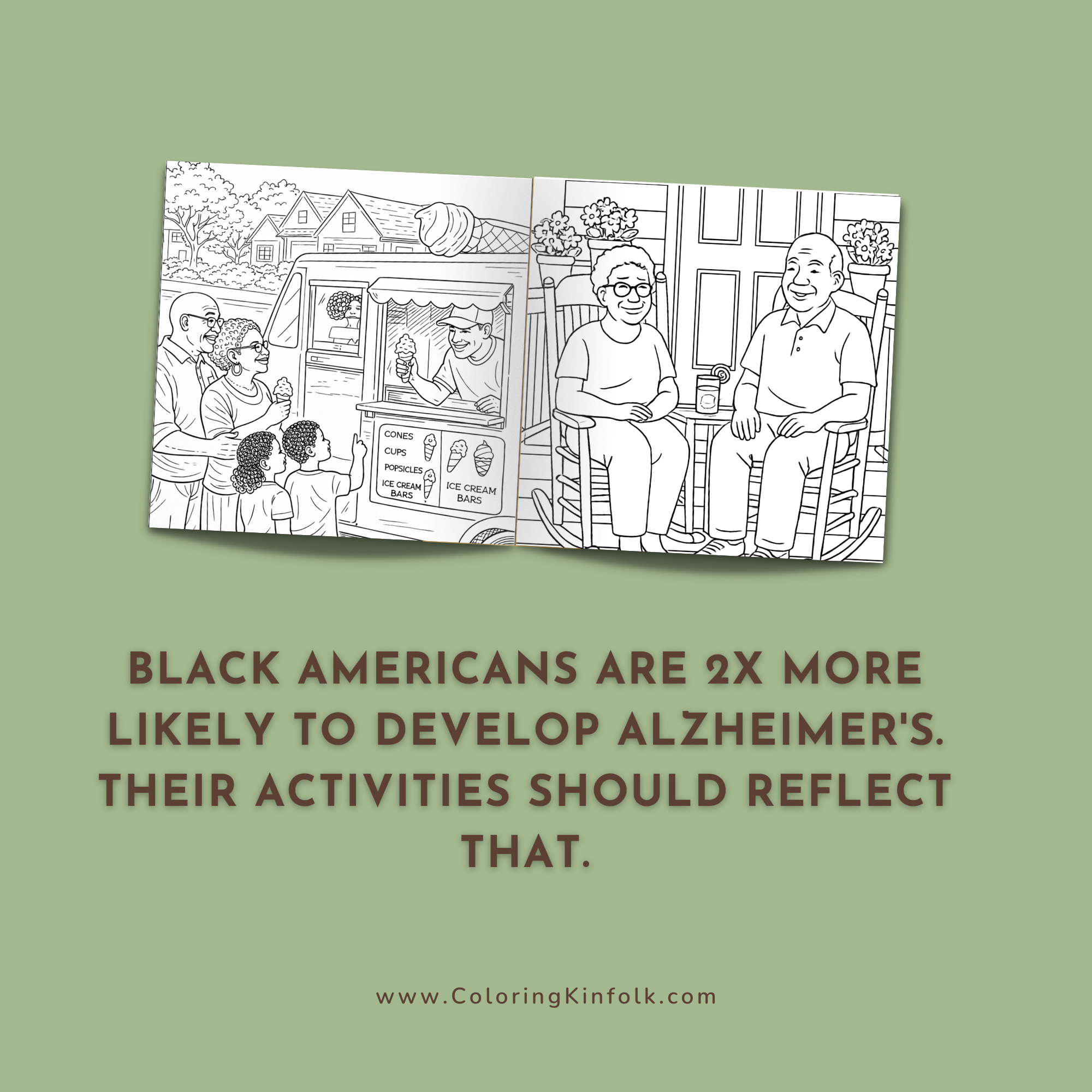
The kitchen (not a generic kitchen; a specific kind with a particular aesthetic). The dining table set for Sunday Dinner. The front porch with rocking chairs. The church sanctuary with particular architectural details.
Community Rituals
Sunday dinner (the food, the gathering, the ritual). Family reunions (the parks, the pavilions, the multi-generational spread). Church homecoming (the hats, the shoes, the choir). Barbershop visits (the chairs, the magazines, the conversation).
Intergenerational Relationships
Grandparents in the kitchen teaching grandchildren. Extended family gathered on porches. Neighbors as community (not just proximity, but connection).
Seasonal and Celebratory Moments
Juneteenth celebrations. Christmas gatherings. Family reunion summers. First days of school. These aren’t generic “holidays”; they’re specific cultural moments.

Generic “diverse” imagery; a brown-skinned figure in an undefined space, a “multicultural” family without cultural context; doesn’t activate this kind of memory. It’s representation without recognition.
The Activity Director’s Challenge: Finding the Right Resources
Activity directors are under significant pressure to deliver culturally sensitive programming with limited budgets. What makes an effective nursing home activity book for this population?
Scene-Based Imagery That Mirrors Lived Experience
Not abstract patterns. Not generic landscapes. Recognizable moments from the residents’ actual lives. For Black American elders, this means domestic scenes, church gatherings, community spaces, family traditions.
Large Print and Bold Lines for Accessibility
Bold and easy format is not optional. Fine motor skills decline with age and dementia. Vision changes with age. Standard “adult coloring books” designed for younger audiences often use fine lines (1/16 inch or smaller) that are nearly impossible for elders to see or stay within.
Large print versions use 1/4-inch thick lines, clearly defined shapes, and high-contrast designs. This isn’t “simplified” content; it’s accessible content.
Print Licensing That Allows Facility Use
This is where many facilities get stuck. You cannot legally purchase a consumer digital download ($10-$15 on Etsy) and print 40 copies for your residents. That’s copyright infringement. Consumer licenses are for personal use only.
Institutional settings need bulk licenses that explicitly grant print rights for facility-wide use. These typically range from $197-$297 depending on the collection size and usage terms.
Cultural Specificity That Reflects Resident Demographics
A facility serving predominantly Black American elders from Southern backgrounds needs different materials than a facility serving predominantly white European-American elders from Midwestern backgrounds. One size does not fit all.
Cultural competence in memory care isn’t just about staff diversity (though that matters). It’s about ensuring the materials reflect the cultural world of the people being served.
RELATED: From Journals to Coloring Books: Why Creative Rituals Matter for Black Families
The Institutional Licensing Gap
A critical structural problem: digital downloads sold to individual consumers are not licensed for institutional use. A facility cannot legally purchase one PDF and print 40 copies without an institutional license.
This creates a gap. Activity directors with $200 budgets look at $15 Etsy downloads and think “I can just buy one and print copies.” But that’s not legal. And it’s not sustainable for the artists and publishers creating these materials.
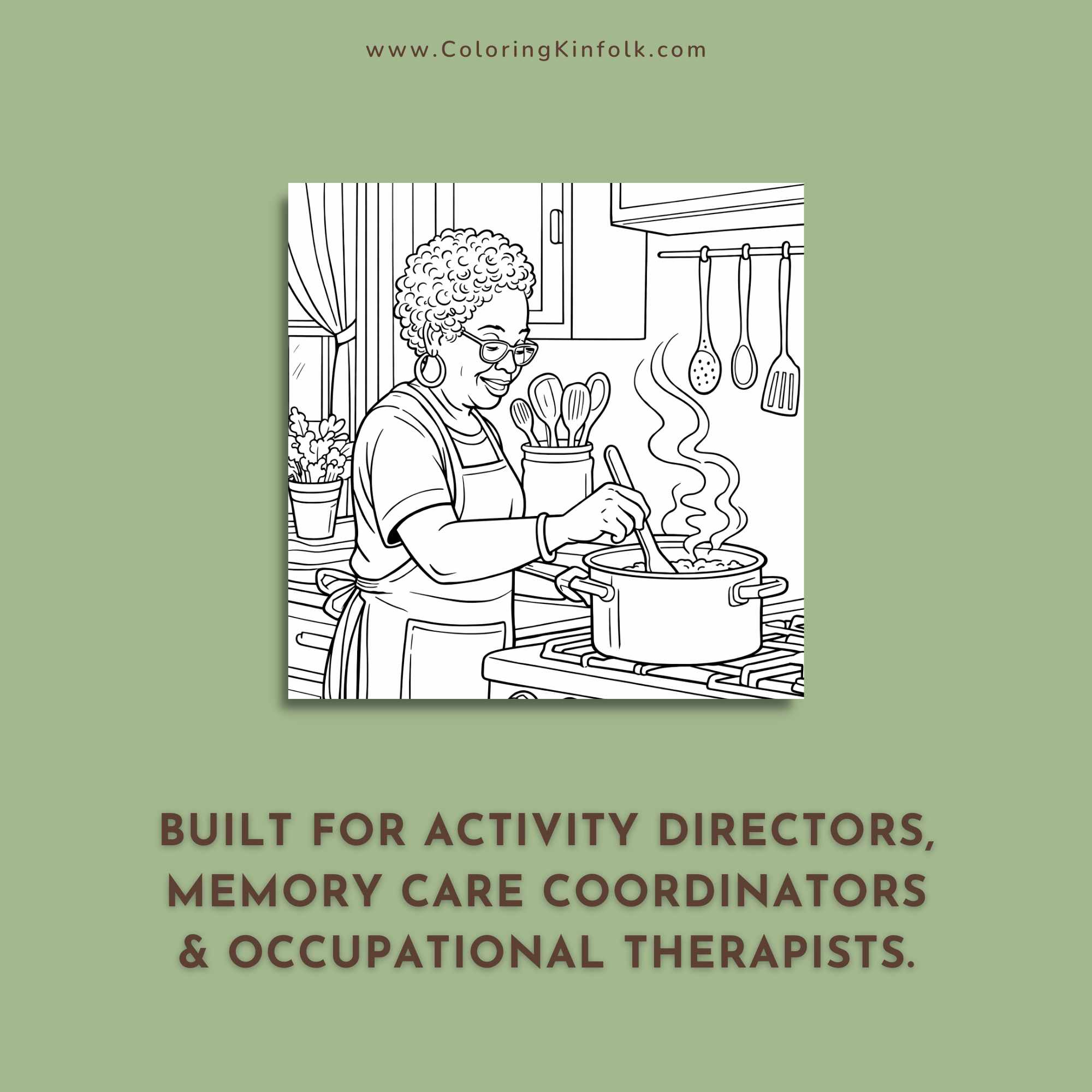
Coloring Kinfolk’s bulk licenses start at $197 and include print rights for facility-wide use, purpose-built for recreation therapy programs, not consumer downloads. The pricing reflects the difference: you’re licensing for institutional use, not personal use.
What Facilities Should Ask Before Buying
Before purchasing any memory care coloring materials, activity directors should ask:
Does This Imagery Reflect Our Specific Resident Population?
Not “Is this diverse?” but “Would my residents recognize this as their life?” There’s a difference.
Are Lines Large and Bold Enough?
Can residents with macular degeneration or other age-related vision changes see the lines clearly? Can residents with tremors or declining fine motor control stay within the shapes without frustration?
Does the License Allow Group Use?
Can you legally print copies for your recreation therapy programming? Or is this a consumer product you’re trying to repurpose?
Is There Enough Variety?
Can you sustain programming across multiple sessions (weekly coloring groups for 6 months, for example)? Or will residents see the same images over and over?
Is This Purpose-Built or Repurposed?
Was this created specifically for memory care settings with input from activity directors and recreation therapists? Or is this a consumer product being marketed to facilities as an afterthought?
Real Implementation: What Works in Practice
“We started using culturally specific coloring pages in our memory care wing six months ago. The difference is remarkable. Residents who barely engaged with generic mandala books are now asking when it’s coloring time. They tell stories while they color. They request specific scenes. It’s not just an activity anymore; it’s connection.”
— Memory Care Coordinator, Philadelphia skilled nursing facility
“The institutional license was worth every penny. We’re able to print copies for our weekly groups, our one-on-one sessions, and our family engagement programming. And knowing we’re legally compliant matters for our accreditation.”
— Activity Director, Atlanta assisted living community
Building a Culturally Competent Memory Care Program
Coloring isn’t the whole answer. But it’s part of the answer. When combined with culturally specific music programming, food choices that reflect residents’ backgrounds, staff training on cultural competence, and environmental design that honors residents’ lived experiences, therapeutic coloring becomes one tool in a comprehensive approach.
The research supports this. The outcomes data supports this. Families notice the difference. Residents engage more deeply.
The question isn’t whether cultural specificity matters. The research answered that question years ago. The question is: when will memory care facilities start operationalizing what the research already knows?
RELATED: Nostalgia Isn’t a Backwards Step—It’s Your Anchor
Institutional Solutions: Purpose-Built Memory Care Resources
The research is clear: culturally specific reminiscence therapy produces better outcomes than generic programming. Your residents deserve materials that reflect their lived experiences, not generic content designed for a different population.
Coloring Kinfolk offers institutional licensing for memory care facilities, assisted living communities, nursing homes, and senior centers. Bulk licenses starting at $197 include print rights for facility-wide recreation therapy programming. Purpose-built for Black American elder populations with culturally specific imagery, large print format, and bold accessible design.
Leave a Reply